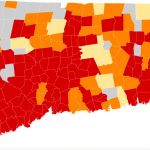
People tend to look at maps as information that should be taken as fact without the need for analysis, but that’s a mistake. When the average person consumes information through sources like television, radio, a website, or a newspaper, they might do it with a critical eye. What is the viewpoint of the news outlet? Has it been trustworthy in the past? Is there another source for this information to get a second opinion? A map is different. People tend to look at maps as absolute information that should be taken as fact without analysis. But that’s a mistake, according to a pair of UConn professors from the Neag School of Education in a recent article published in Social Studies Research and Practice.
When the average person consumes information through sources like television, radio, a website, or a newspaper, they might do it with a critical eye. What is the viewpoint of the news outlet? Has it been trustworthy in the past? Is there another source for this information to get a second opinion? A map is different. People tend to look at maps as absolute information that should be taken as fact without analysis. But that’s a mistake, according to a pair of UConn professors from the Neag School of Education in a recent article published in Social Studies Research and Practice.
Museums provide students with opportunities and resources not available in the classroom. Through the physical participation of seeing, feeling, touching and overall experiencing the past, field trips to these sites and their corresponding lesson plans are crucial for successful learning in youth. UConn’s Alan Marcus, Ph.D., associate professor of curriculum and instruction in the Neag […]